AI for Real Estate Agents — 120 Prompts for Listings, Leads & Content | Learn AI Smart

The Practical Business Series · eBook

AI for Real Estate Agents

Generate leads, listings and social media content

Engr. Imran Umar Lodhi

120 prompts for the three jobs that eat an agent’s week — plus the thing most prompt books for this industry leave out: a serious treatment of the rules your licence is attached to.

$1.99

  • PDF edition
  • 126 pages
  • 120 prompts
  • Fair housing discipline built in
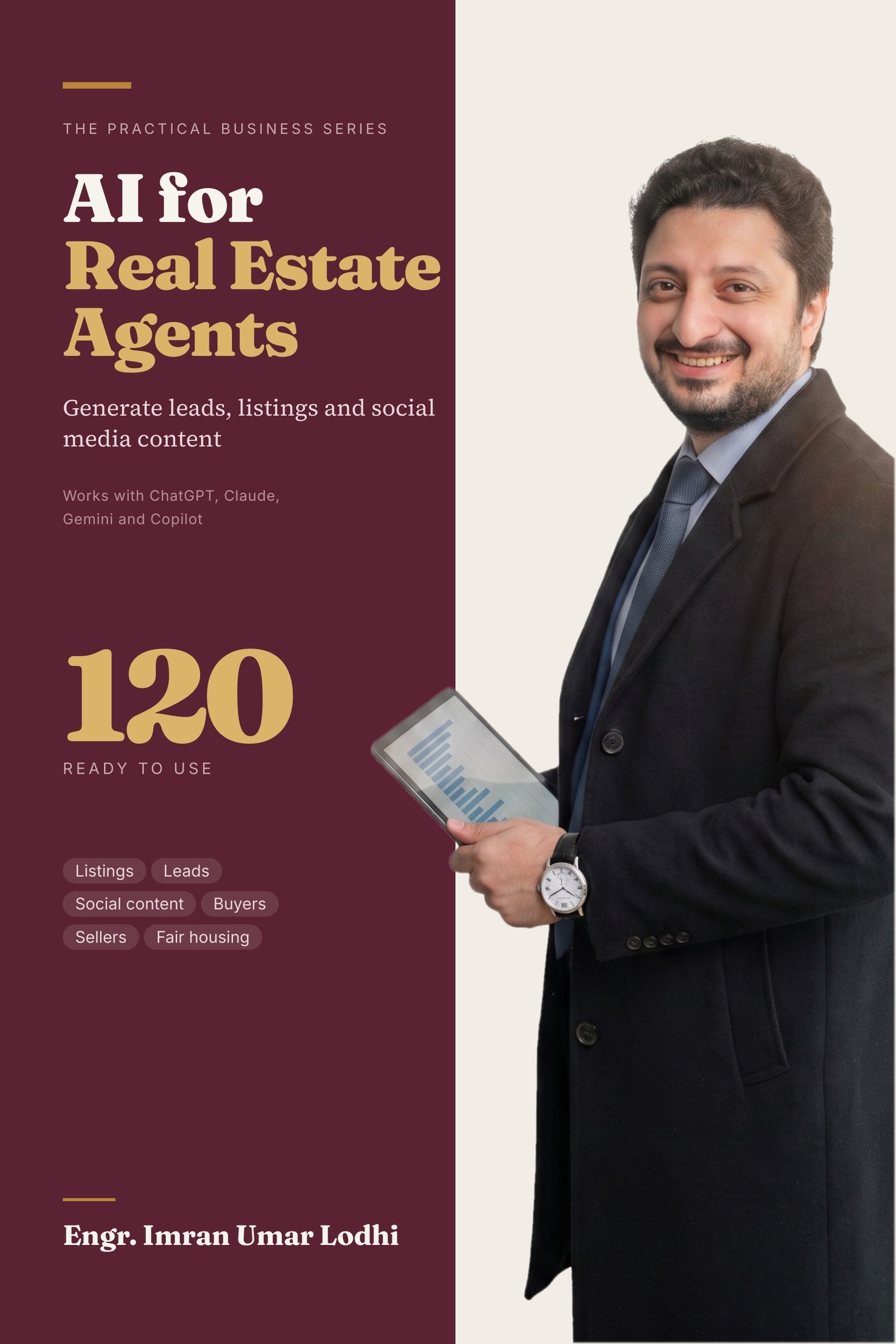
Cover of AI for Real Estate Agents: generate leads, listings and social media content, by Engr. Imran Umar Lodhi

120 Prompts

Ready to fill in and run

8 Sections

Listings, leads, content, sellers, buyers

4 AI Assistants

ChatGPT · Claude · Gemini · Copilot

Compliance-Aware

Written for a licensed profession

The one rule from the whole book

Describe the property. Never describe the buyer.

Almost every fair housing problem in AI-generated listing copy comes from a sentence that starts with “perfect for” and ends with a type of person. The models were trained on decades of copy written before enforcement caught up, so that phrasing is exactly what the pattern tells them a property description looks like.

The tools have no idea they are doing it. You are the one whose licence is attached. Every prompt in the listing and content sections carries that discipline inside the instruction rather than bolted on afterwards.

Where the hours are

One set of property facts. Six pieces of copy. Five minutes.

MLS remarks, a portal summary, an Instagram caption, a flyer paragraph, an email and a text used to be forty minutes of retyping. That, plus a month of social content produced in one sitting, is the single biggest recoverable block in most agents’ weeks.

It drafts. You verify and decide.

And the four things it will get wrong

  • Fair housing language, constantly and by default. Chapter 3 is devoted to it.
  • Features that do not exist. A fireplace, a finished basement, a renovated kitchen. Check every feature against the property data.
  • Numbers. Square footage, taxes, closing costs, days on market. Confidently produced and often wrong.
  • Your market. It does not know your inventory, your comparables, or that the street with the nice houses backs onto a rail line.

The library

120 prompts, in eight sections.

Each prompt says when to use it, gives you the fill-in-the-brackets text, and where the rules bite, tells you what to check before you publish.

Section 01 · Prompts 1–22

Listings & Property Descriptions

The fastest win in the book and the one with the most exposure attached. The standard description, the variations for every channel, and a compliance pass you run before anything reaches the MLS.

Section 02 · Prompts 23–42

Lead Generation & Prospecting

Expired listings, the objection you have not rehearsed, and the follow-up you would otherwise never get round to. The research and the script — with a clear note that do-not-call and consent rules apply however the words were written.

Section 03 · Prompts 43–66

Social Media & Content

Compress a month of posting into one sitting — starting with a prompt that teaches the model your own voice from your existing writing, so the output does not read like everyone else’s.

Section 04 · Prompts 67–80

Working With Sellers

The listing presentation, the pricing conversation and the offer discussion — prepared properly rather than improvised. AI structures the reasoning; the number stays yours, and it is not an appraisal.

Section 05 · Prompts 81–94

Working With Buyers

Where steering risk is highest, because buyers ask the questions that invite it. Consultations, tour plans and explanations written to point at objective data sources and let clients draw their own conclusions.

Section 06 · Prompts 95–106

Client Communication & Admin

Build a message library for the twenty situations that recur, so you edit rather than compose. The delay and bad-news messages are worth having ready before the day you need them.

Section 07 · Prompts 107–114

Your Brand & Local Authority

Every agent has the same portals, data and tools. The difference is what you know about your area that nobody else has bothered to write down. This section is about building that.

Section 08 · Prompts 115–120

Your Business, Admin & AI Setup

Audit where your week actually goes, decide what to delegate, template, automate or stop — and the final prompt, which teaches you to write your own.

Get This eBook — $1.99

PDF · 126 pages · yours to keep

How to brief it properly

Five ingredients, in an order you will remember: H·O·M·E·S

A thin brief gets you copy that could describe any house in the country. Chapter 2 explains the structure every prompt in the library is built on — and prompt 120 teaches you to write your own.

  1. Home

    The property or situation, stated as verified facts — not as adjectives you hope are true.

  2. Objective

    What you want produced and where it will appear. MLS remarks and an Instagram caption are different requests.

  3. Market

    Your area, price band, comparable stock and current conditions — the knowledge the model does not have.

  4. Evidence

    Your past copy, your voice brief, your real data. This is what stops the output sounding like every other agent’s.

  5. Safeguards

    Property only. No buyer profiling. Nothing invented. The three constraints that keep the draft publishable.

Reference section

A cheat sheet you print and keep where you write listings.

Plus: When The Output Is Wrong — a troubleshooting table of what you got, why, and the exact follow-up that fixes it. A glossary. Sources and further reading. And an index of all 120 prompts, so the book works as a reference you raid rather than a book you read once.

Nothing in the book is legal advice. Requirements vary by country, state, MLS and brokerage, and they change — your broker and your attorney remain the authority on your situation.

A sample of “never publish these”

  • “Perfect for” or “ideal for”, followed by any type of person
  • Family, family-friendly, starter home, bachelor pad, empty nesters
  • Safe, quiet, exclusive, established, desirable area
  • Any mention of schools, school ratings, places of worship or crime
  • Any description of who lives in an area, or who would like the home

The full list, with the safer phrasing to use instead, is in the book.

Who it’s for

Written for practising agents.

  • Licensed agents doing their own marketing
  • New agents building a content and prospecting system
  • Experienced agents who want the compliance side handled properly
  • Team leaders standardising how their agents use AI
  • Brokerage trainers building an internal AI policy
  • Transaction coordinators and marketing assistants

This book may not be for you if…

  • …you want a shortcut around knowing your market. The prompts assume you know your comparables, your inventory and your area — that knowledge is what makes the output useful.
  • …you want legal answers. The book will help you ask your broker and attorney better questions; it will not replace them.
  • …you want to publish drafts unread. Every listing prompt ends with something for you to verify.
  • …you are after a review of real-estate AI products. This is about the structure of a good request, which outlasts the tools.

We would rather you skip the book than be disappointed by it.

Engr. Imran Umar Lodhi

About the author

Engr. Imran Umar Lodhi

Engineer · Educator · Trainer · Author

An electrical engineer, former university lecturer and professional trainer with more than fifteen years of experience in engineering, leadership, research and professional development, and a certified ISO 9001 and ISO 45001 Lead Auditor — a background in regulated work that shows in how this book treats compliance.

His interest in AI grew from one question: how can it save professionals time without replacing the knowledge, experience and judgment that make their work valuable?

writetolodhi@gmail.com

Reader reviews

What agents say

Questions

Before you buy

What format is the eBook?

A PDF of about 126 pages. It reads well on a phone, tablet or laptop and prints cleanly.

Which AI tools do the prompts work with?

ChatGPT, Claude, Gemini or Copilot. Nothing here needs a real-estate-specific AI product, though several exist and some are good.

Is this legal advice on fair housing?

No. Fair housing, licensing, advertising, disclosure and prospecting requirements vary by country, state, MLS and brokerage, and they change. Your broker and your attorney are the authority on your situation. What the book does is make you far better at spotting the problem before it is published, and better at asking them the right questions.

Will the prompts produce compliant listing copy?

The discipline is written into the instruction, and there is a dedicated compliance-pass prompt plus a list of phrases never to publish. But you review and you publish: licensed professionals remain solely responsible for all content, however it was produced.

Can AI value a property?

No. It can structure your reasoning and organise your comparables, but the number is yours, based on your data and judgement — and it is not an appraisal.

Can I share the PDF with my team?

No — the book is copyright protected and the file may not be redistributed. You may freely use and adapt the prompts in your own practice. For a team or brokerage licence, email us and we will sort something out.

What if I have a download problem?

Email writetolodhi@gmail.com or message +92 334 604 7727 on WhatsApp. Purchase terms are in the Return & Refund Policy.

The listing goes live tomorrow. The copy does not have to take your evening.

  • 120 prompts across 8 sections
  • Fair housing discipline written into the prompts
  • 126-page PDF, cheat sheet included

Immediate digital access after successful payment.

AI for Real Estate Agents

PDF · 120 prompts

Get This eBook — $1.99