AI for Small Business Owners — 100 Prompts to Save 10 Hours a Week | Learn AI Smart

The Practical Business Series · eBook

AI for Small Business Owners

100 prompts to save 10 hours a week

Engr. Imran Umar Lodhi

For owners doing too many jobs at once. 100 prompts organised by the job you are trying to get done — marketing, quotes, customer replies, processes, pricing, delegation and the decisions you keep putting off.

$1.99

  • PDF edition
  • 109 pages
  • 100 prompts
  • Works with ChatGPT, Claude, Gemini or Copilot
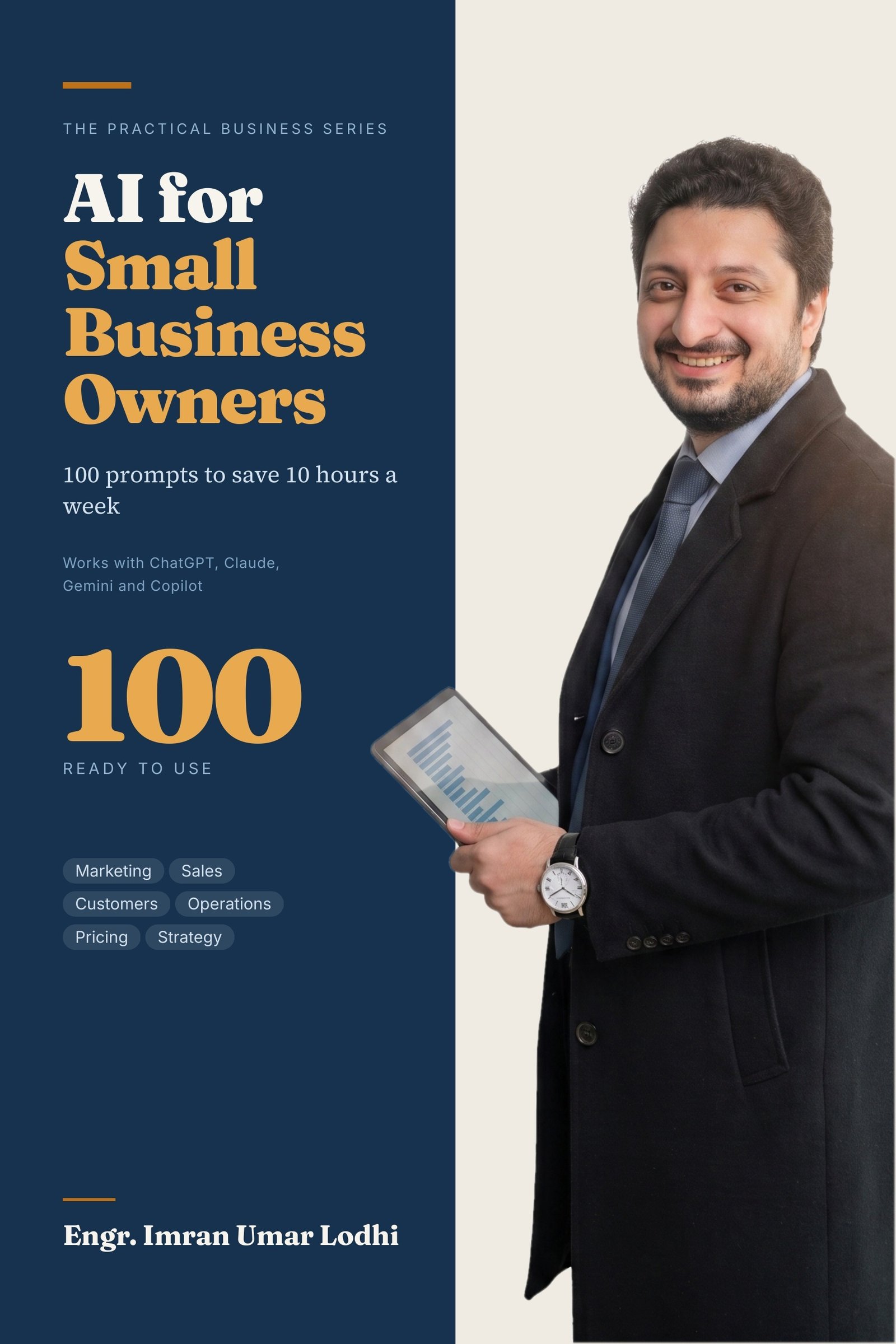
Cover of AI for Small Business Owners: 100 prompts to save 10 hours a week, by Engr. Imran Umar Lodhi

100 Prompts

Fill in the brackets and run

8 Sections

Marketing to strategy

4 AI Assistants

ChatGPT · Claude · Gemini · Copilot

Honest Numbers

Sourced, not invented

Chapter 1, before you pay anything

Ten hours is the upper end. Six to eight is typical.

Most books like this open with an inflated statistic. This one opens with the real ones, because you will make better decisions with an accurate picture than a flattering one. The book cites the 2025–2026 small-business surveys directly and tells you where the numbers cluster.

The gap between the average and the upper end is not about being clever with technology. It comes down to three things, all within your control — and Chapter 1 names them before the library starts.

Nothing in the book claims AI runs your business, talks to customers unsupervised, or makes your decisions. The hours come from drafting, structuring and documenting. That is the honest scope.

Where the hours are

The work that is nearly the same every time.

The follow-up, the quote, the twentieth answer to the same question, the month of posts, the process that only exists in your head. None of it should be written from scratch.

What should never be handed over is the judgement: whether this customer is worth pursuing, what price to hold, what to do next.

A realistic week, from the book
AreaTypical saving
Marketing and content3–4 hours
Customer communication2–3 hours
Admin and documentation2–3 hours
Thinking and planning1–2 hours

The last row is less about speed and more about not stalling for three days on a decision.

The library

100 prompts, in eight sections.

Every prompt has square brackets in it. The brackets are where your business goes — your customers, your margins, your quiet season, the objection you hear every week.

Section 01 · Prompts 1–20

Marketing & Content

Where owners report the biggest gains and where the work never ends. A month of posts written on a Sunday afternoon, a website page that explains what you actually do — starting with a prompt that teaches the model your own voice.

Section 02 · Prompts 21–34

Sales, Leads & Proposals

The follow-up, the quote, the answer to the same objection — drafted, not composed. Cold outreach that is not spam. The judgement about who to pursue and what price to hold stays with you.

Section 03 · Prompts 35–46

Customers & Difficult Conversations

Build a reply library for the same twenty situations, so you edit rather than write fresh at the end of a long day. The conflict prompts are worth having ready before you need them.

Section 04 · Prompts 47–60

Operations, Admin & Systems

The least glamorous section and probably the most valuable. Getting the process out of your head and onto paper is the only real route to eventually handing the job to someone else.

Section 05 · Prompts 61–72

Money: Pricing, Cash Flow & Costs

For the reasoning, not the arithmetic — most pricing mistakes are failures of reasoning anyway. Work out what you should actually charge, when your price was set years ago by guesswork.

Section 06 · Prompts 73–82

Hiring, Team & Delegation

Whether you have twelve staff or none, the bottleneck is the work only you know how to do. The job advert, the difficult conversation, and the harder question of what to hand over first.

Section 07 · Prompts 83–92

Strategy, Planning & Decisions

Running a small business is lonely in a specific way: nobody to think out loud with who has no stake in the answer. A thinking partner that will argue with you — starting with “argue against my plan”.

Section 08 · Prompts 93–100

Your Own Time & AI Setup

Where your hours actually go, what to hand over permanently, and how to write your own prompts so you stop needing books like this one. Prompt 100 is the one to keep.

Get This eBook — $1.99

PDF · 109 pages · yours to keep

Chapter 2 — the shortest and most useful

A prompt is a container. You are the content.

Copy a prompt, paste it unchanged, get something generic, conclude AI is overhyped — that is a fair reaction to a badly used prompt and the wrong conclusion about the tool. Five ingredients fix it.

  1. Business

    What you do, for whom, at what scale, where. Written once as a standing context block you paste into everything.

  2. Role

    Who the AI should be for this task — a sceptical advisor and a copywriter give very different answers.

  3. Intent

    What you want produced and what it is for. A quote you will send today is a different request from a template.

  4. Evidence

    Your real emails, posts, numbers, reviews and past work. This is what stops the output sounding like everyone else’s.

  5. Format

    Length, shape, tone, and what to avoid. Twelve extra words buy you something you can actually send.

  6. If you only have ten minutes

    Read Chapter 2, run prompt 95 to build your context block, and prompt 93 to find where your week actually goes. Those two make every other prompt work better.

Chapter 3

Three ground rules, about a minute each.

The risks are not dramatic. They are the ordinary ones: pasting a customer list into a free chatbot, publishing a number that turns out to be wrong, or making a claim in an advert you cannot back up. All three are avoidable.

  1. Your customers’ data is not yours to feed in

    Free and consumer tiers may retain what you type. Assume anything pasted into a free account could be seen outside your business — and the book shows how to get the same output without it.

  2. Never publish a number you have not checked

    These tools produce confident, wrong figures without hesitating. Do the sums yourself, and take anything consequential to your accountant.

  3. You are responsible for what you claim in public

    Nothing in the book is legal, tax, financial or employment advice, and nor is anything a chatbot tells you. Your obligations are the same however the words were produced.

Who it’s for

Owners doing too many jobs at once.

  • Trades, shops, restaurants and clinics
  • Agencies and consultancies
  • Online sellers and e-commerce operators
  • One-person operations and teams of twenty
  • Owners preparing to delegate for the first time
  • Anyone whose marketing keeps slipping to next week

This book may not be for you if…

  • …you want the AI to run the business. It drafts, structures and documents. You decide.
  • …you want accounting, legal or employment answers. Take those to a qualified professional; the book will help you arrive with better questions.
  • …you will not fill in the brackets. A prompt pasted unchanged produces exactly the generic output that makes people give up.
  • …you want a tool comparison. Tools change every few months; the structure of a good brief does not.

We would rather you skip the book than be disappointed by it.

Engr. Imran Umar Lodhi

About the author

Engr. Imran Umar Lodhi

Engineer · Educator · Trainer · Author

An electrical engineer, former university lecturer and professional trainer with more than fifteen years across engineering, leadership, research and professional development, and a certified ISO 9001 and ISO 45001 Lead Auditor — a background in process and documentation that shows in how this book treats operations.

His interest in AI grew from one question: how can it save professionals time without replacing the knowledge, experience and judgment that make their work valuable?

writetolodhi@gmail.com

Reader reviews

What owners say

Questions

Before you buy

Will I really save ten hours a week?

Chapter 1 answers this before you read anything else. Across the major 2025–2026 surveys, a typical owner using these tools reasonably well saves six to eight hours a week. Ten is the upper end, reached by owners who produce a lot of marketing content and who build AI into their workflow rather than opening a chatbot when they remember to.

Do I need to be technical?

No. Nothing in the book requires a subscription, a developer, or a tool you do not already have.

Which AI tools do the prompts work with?

ChatGPT, Claude, Gemini or Copilot. The prompts are organised by the job you are trying to get done, not by the tool.

What kind of business is it for?

Trades, shops, agencies, consultancies, restaurants, clinics, online sellers — one-person operations and teams of twenty alike. If you are doing several jobs at once, the prompts will fit.

Is it safe to put my customer data in?

No — and Chapter 3 is explicit about it. Free and consumer tiers may retain what you type and use it to improve their systems. Your customers’ data is not yours to feed in. The book shows how to get the same quality of output without pasting it anywhere.

Can I share the PDF with my team?

No — the book is copyright protected and the file may not be redistributed. You may freely use and adapt the prompts in your own business. For a team licence, email us and we will sort something out.

What if I have a download problem?

Email writetolodhi@gmail.com or message +92 334 604 7727 on WhatsApp. Purchase terms are in the Return & Refund Policy.

Get the repetitive writing off your evenings.

  • 100 prompts across 8 sections
  • Honest, sourced numbers on what to expect
  • 109-page PDF, cheat sheet included

Immediate digital access after successful payment.

AI for Small Business Owners

PDF · 100 prompts

Get This eBook — $1.99