AI for Teachers — 150 AI Prompts for Lesson Plans, Quizzes & Feedback | Learn AI Smart

The Practical Classroom Series · eBook

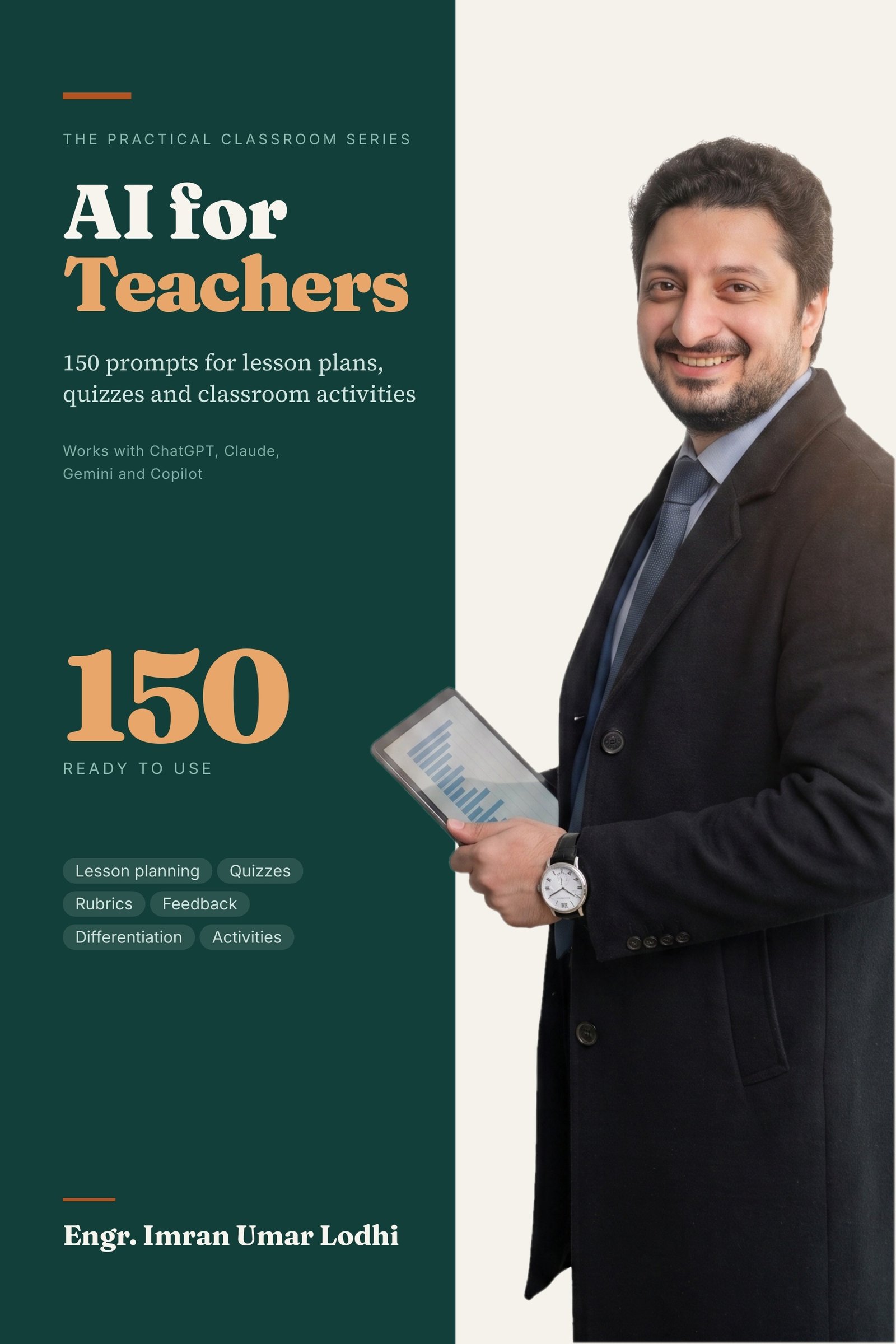
AI for Teachers

150 Prompts for Lesson Plans, Quizzes and Classroom Activities

Engr. Imran Umar Lodhi

A working reference for classroom teachers. Every prompt is written to produce something you could take into a lesson after a short edit — not something you would need to rewrite from scratch.

$1.99

  • PDF edition
  • 130 pages
  • 150 prompts
  • Immediate download after payment
Cover of AI for Teachers: 150 prompts for lesson plans, quizzes and classroom activities, by Engr. Imran Umar Lodhi

150 Prompts

Ready to customise

8 Practical Areas

From planning to parent communication

4 AI Assistants

ChatGPT · Claude · Gemini · Copilot

Teacher-First

AI assists. You decide.

Why this book exists

Teaching is already a full-time job. Preparation shouldn’t consume your evenings.

The work that eats the hours is rarely the teaching. It is the producing: the third version of a worksheet, the twenty comprehension questions, the rubric you have to write before you can mark anything.

  • Starting tomorrow’s lesson from a blank page at nine at night.
  • Writing a second and third version of the same quiz.
  • Building a rubric before you can begin marking.
  • Producing differentiated material for a class with a wide range.
  • Writing feedback that says something useful, twenty-eight times.
  • The newsletters, the permission letters, the email you keep putting off.
  • Typing a vague prompt into a chatbot and getting generic output back.

This book gives you the starting point — a prompt that already knows what a good answer looks like.

The rule the whole book follows

Outsource the production, keep the judgment.

This is not a book arguing that AI should replace teaching expertise. It argues the opposite. AI is good at producing drafts, volume and variations. It is unreliable about facts, weak on precise reasoning, and it knows nothing about your syllabus or your students.

So the prompts hand it the production and keep the decisions with you: judgment, context, curriculum, accuracy, student needs. Every chapter says the same thing — nothing reaches a student until a qualified educator has read it.

What’s inside

The prompt library, in eight sections.

Organised by the job you are trying to do, so you can find the right prompt in under a minute.

Section 01 · Prompts 1–30

Lesson Plans & Curriculum Design

Complete single-lesson plans with objectives, timings and a prep list. Multi-week unit maps. Dense curriculum standards turned into teachable “I can” objectives. This is where most teachers feel the biggest time saving.

Section 02 · Prompts 31–55

Quizzes, Tests & Question Banks

Multiple choice where every distractor is based on a real misconception, short answers with model answers, bell-ringer banks, and versions of the same test — generated in bulk, checked by you.

Section 03 · Prompts 56–75

Rubrics, Grading & Feedback

Analytic rubrics from scratch, comment banks organised by criterion, two-stars-and-a-wish feedback, whole-class feedback sheets. Marking is the part of the job that follows teachers home; the typing does not have to.

Section 04 · Prompts 76–105

Classroom Activities & Engagement

Structures that have worked in classrooms for decades — think-pair-share, jigsaw, gallery walks — with AI supplying the content, the timing and the exact wording of your instructions rather than inventing gimmicks.

Section 05 · Prompts 106–125

Differentiation & Inclusion

Three tiers of one task against a single objective, reading-level rewrites that cut nothing, scaffolds and extensions. The area where AI changes the arithmetic most — and where the rule is: describe the need, never the student.

Section 06 · Prompts 126–135

Classroom Management & Routines

Co-created norms, transition routines, and scripts for the conversations you dread — drafted and pressure-tested in advance rather than improvised in the moment.

Section 07 · Prompts 136–143

Parent & Family Communication

Newsletters, positive contact home, raising a concern, meeting notes. High-stakes writing where a draft saves fifteen minutes and a good rewrite saves a difficult meeting. You supply the notes; it shapes them.

Section 08 · Prompts 144–150

Your Own Practice, Admin & AI Literacy

Staff meeting and PD outlines, the admin writing nobody enjoys, and the last seven prompts — the ones quietly aimed at making a prompt book unnecessary.

Get This eBook — $1.99

PDF · 130 pages · yours to keep

More than a prompt list

The reference material that makes the prompts stick.

The One-Page Cheat Sheet

The five ingredients, the phrases that consistently improve output, and the phrases that waste your time. Made to photocopy and stick inside a cupboard door.

Your First Thirty Days

One habit a week instead of everything at once: which prompt to start with, what to add in week two, and where the time saving usually becomes obvious.

When the Output Is Wrong

A troubleshooting table: what you got, why it happened, and the exact follow-up message that fixes it — without switching tools or starting again.

Glossary

The AI vocabulary teachers actually meet in staff meetings, explained in plain language.

Sources & Further Reading

Where the guidance in the book comes from, so you can check it and take it to a colleague.

Index of All 150 Prompts

Every prompt by number and title, so the book works as a reference you raid rather than a book you read once.

How the prompts work

Five ingredients, one order teachers don’t forget: C·L·A·S·S

“Write me a lesson plan on fractions” is a generic request, so it gets a generic answer — the model fills the gaps with averages. Every prompt in this book is built on a structure that closes those gaps before you press enter.

  1. Context

    Who should the AI be, and what is the situation? Your subject, the lesson length, the room, the resources you actually have.

  2. Learners

    Who is in front of you and what do they already bring? Grade, class size, prior knowledge, the range — described by need, never by name.

  3. Aim

    What do you want produced, and what will you do with it? A guided practice sheet is a different request from a formative check.

  4. Shape

    What form should the output take? A printable table, a set length, an answer key at the end. Twelve extra words buy you something you can print.

  5. Standards

    What must the result meet, and what must it avoid? Curriculum alignment, constraints, and the assumptions you do not want in front of your class.

Chapter 2 also shows you how to write your standing context block once, so two of the five ingredients are handled before you type a word.

Preview the book

Three prompts, shown abridged.

Anything in [square brackets] is where your professional knowledge goes. The prompt is the container; you are the content.

Prompt 001 The complete single-lesson plan Your everyday workhorse.

“You are an experienced [subject] teacher who plans lessons for [grade level] students. Write a complete lesson plan for a [45/60/90]-minute lesson on [topic].”

…then eight numbered requirements, from measurable objectives to a timing column and a prep list. (abridged)

Prompt 033 Exit tickets The last three minutes of every lesson.

“Write 5 different exit tickets for a lesson on [topic] at [grade level]. Each should take a student under 3 minutes. Vary the format…”

…and it tells the model to explain what to look for when you sort them into piles. (abridged)

Prompt 106 Three tiers of the same task One lesson, one objective, three entry points.

“Here is my task: ‘[paste it]’, for [grade level] on [topic]. Create three versions targeting the same learning objective…”

…with scaffolding, step size and vocabulary support specified for each tier. (abridged)

Get All 150 Prompts

Every prompt comes with a note on when to reach for it — and, where it matters, a tip underneath.

Who it’s for

Written for people who teach.

  • Classroom teachers, in any subject
  • New teachers building their first resource bank
  • Experienced teachers starting to use AI properly
  • Department heads and instructional coaches
  • Tutors and private teachers
  • Anyone producing differentiated material for a wide range
  • Teachers carrying a heavy planning and assessment load

This book may not be for you if…

  • …you want AI to teach the lesson for you. The prompts assume you know your subject and your students — that is precisely why they work.
  • …you are looking for a shortcut around curriculum knowledge. Nothing here substitutes for the specification in front of you.
  • …you want to publish output without reading it. Every chapter insists that a qualified educator checks the work first.
  • …you expect a tool review. Tools change every few months; this book is about the structure of a good request, which does not.

We would rather you skip the book than be disappointed by it.

How you get it

  1. Step 01

    Choose

    You are on the page. Read the contents above and decide.

  2. Step 02

    Purchase

    Tap Get This eBook and complete payment on our external payment provider’s page. We never see your card details.

  3. Step 03

    Download

    The provider redirects you to your private download page. Save the PDF to your device and it is yours to keep.

Engr. Imran Umar Lodhi

About the author

Engr. Imran Umar Lodhi

Engineer · Educator · Trainer · Author

An electrical engineer, former university lecturer and professional trainer with more than fifteen years of experience in engineering, leadership, research and professional development. He taught engineering students at Bahauddin Zakariya University, Multan — Power System Protection, Power Transmission and Distribution, and High Voltage Engineering.

His interest in AI grew from one question: how can it save professionals time without replacing the knowledge, experience and judgment that make their work valuable? That question is the whole argument of this book.

  • MS Electrical Engineering — Power Systems
  • MBA
  • BS Electrical Engineering
  • ISO 9001 & ISO 45001 Lead Auditor

writetolodhi@gmail.com

Reader reviews

What teachers say

Questions

Before you buy

What format is the eBook?

A PDF of about 130 pages. It reads well on a phone, tablet or laptop, and prints cleanly if you prefer paper.

Do I need ChatGPT Plus?

No. Nothing in the book depends on a paid subscription or a specialist education platform. The prompts are written to work on the free tiers of the major assistants.

Which AI tools can I use?

ChatGPT, Claude, Gemini, Copilot, or whichever comparable assistant your school has approved. The prompts are written for the job, not for a particular tool.

Is this book only for one subject?

No. Every prompt contains square-bracket fields for your subject, grade level, class context and constraints, so the same prompt adapts across subjects and ages.

Does AI replace the teacher’s judgment?

No — and the book says so repeatedly. Output must be reviewed by a qualified educator before it reaches students: numbers worked through, sources verified, curriculum alignment checked against the actual specification.

How do I receive the eBook?

After successful payment, the payment provider redirects you to a private download page on this site where you download the PDF. Save it to your device.

Can I use the prompts in my classroom?

Yes. Purchasers may freely use and adapt the prompts in their own teaching practice, and may reproduce the book’s one-page cheat sheet for personal classroom use.

Can I share the PDF with others?

No. The book is copyright protected: it may not be reproduced, distributed or transmitted in any form without the copyright holder’s written permission, apart from brief quotations in reviews. The classroom permission covers your own use and adaptation of the prompts — not passing on the file. If a colleague wants a copy, please send them here.

What if I have a download problem?

Email writetolodhi@gmail.com with the name you paid under and we will get the file to you. Purchase terms are set out in the Return & Refund Policy, and delivery in the Service Delivery Policy.

Your next lesson doesn’t have to start with a blank page.

Get 150 practical AI prompts built around the work teachers already do — plus the cheat sheet, the thirty-day plan and the troubleshooting table.

  • 150 prompts across 8 practical areas
  • 130-page PDF, yours to keep
  • Works with ChatGPT, Claude, Gemini or Copilot

Immediate digital access after successful payment.

AI for Teachers

PDF · 150 prompts

Get This eBook — $1.99